Via ferratas are an adventure sport that has become very popular in recent years, and Catalonia already has quite a few of them: in the mountains, on the coast, for beginners or for more experienced people…
In this article we explain everything, eeeverything about the subject: what via ferratas are, where to find the best via ferratas in Catalonia, the different grades that exist, the gear you need to bring to do a via ferrata, the best time of year to do them, why to go with a guide and much more.
Ready to climb into the world of via ferratas?
Strap on your helmet, here we go!
The complete guide to via ferratas
What are via ferratas?
A via ferrata is a sports route set on rocky mountain walls, equipped with fixed gear to make progression safe.
The name comes from Italian, «via ferrata», which means «iron path».
In a via ferrata you’ll find iron rungs, steel cables (lifeline), chains and Tibetan or Nepalese bridges (and other elements we explain here) that let you climb the wall comfortably.
It’s the perfect combination of hiking and climbing!
If you want an adrenaline experience for couples, groups and families, don’t miss our via ferratas in the Pyrenees.
History of via ferratas
To understand the origin of via ferratas we have to travel back more than 100 years to the Dolomites, in the Italian Alps.
There, during the First World War, soldiers began equipping routes across the Dolomite peaks with iron.
And why did they do it? Because the mountains in this area are very rocky and the soldiers needed to move across the terrain faster. The iron, rungs and chains sped up their movements a lot and, above all, let them progress through tricky mountain passes and complete these routes safely.
Did you know that the first via ferratas still exist in the Dolomites? If you visit the area, you can see them up close!
These routes fell out of use and were brought back around the 1950s for leisure and sport. Since then, via ferratas have kept evolving and spreading around the world, letting a wide variety of people enjoy the mountains thanks to their equipment.
And that’s exactly what we explain in the next section:
What can we find on a via ferrata?
Bridges, rungs, chains… these are the most common elements, but via ferrata designers are increasingly innovative and keep inventing new challenges to make it a really fun and exciting sport.
That must be why more and more people are getting hooked on this world!
But… do you know what kind of equipment and elements you can find when you do a via ferrata? Here we explain them one by one!
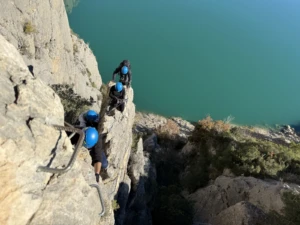
Rungs: a kind of iron step fixed into the rock that helps us move easily along the routes. We’ll find them at a certain distance (more or less spaced depending on the grade) so we can support ourselves with both feet and hands.
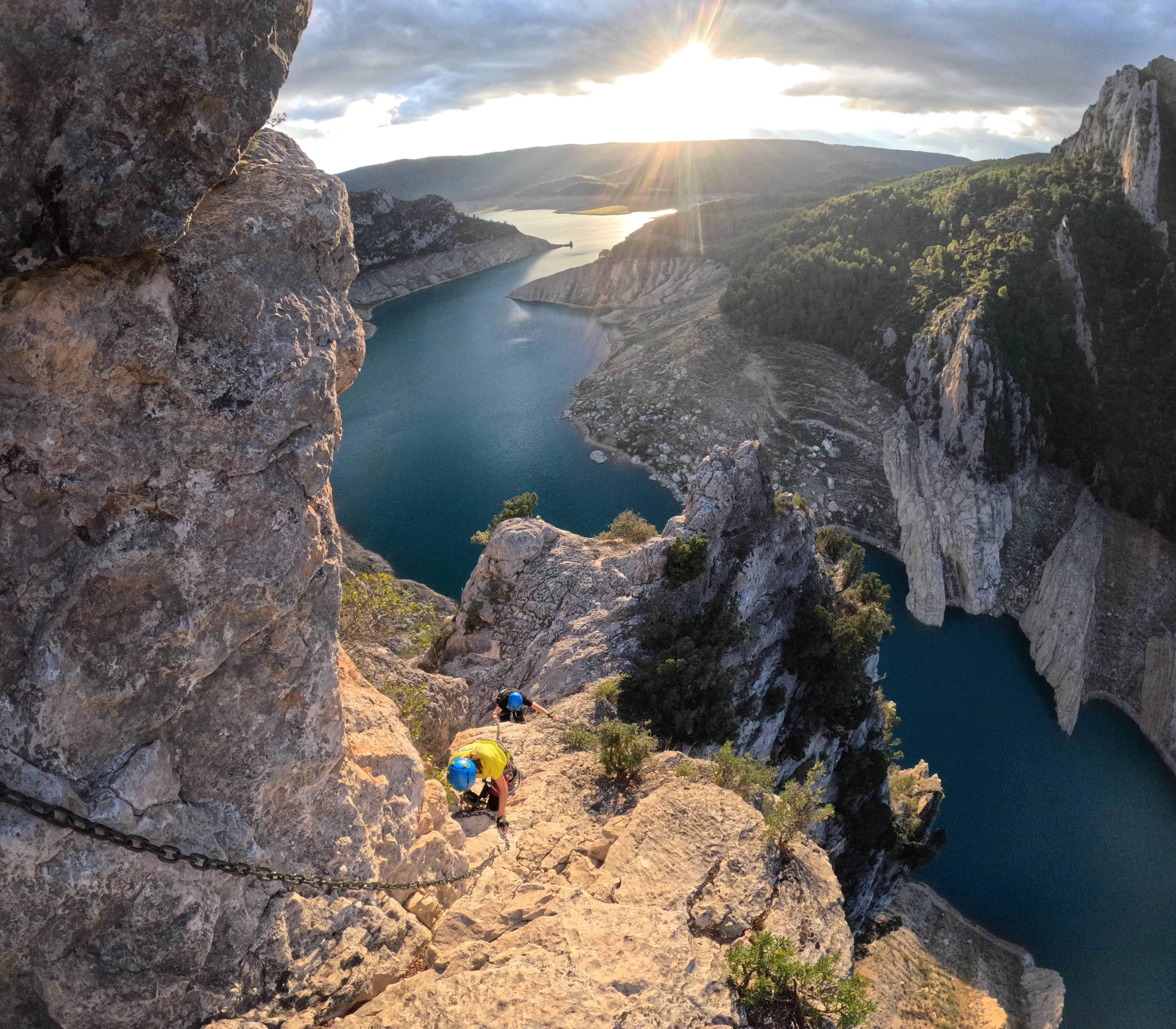
Chains: this element helps us go up or down by pulling with our arms to get past a more or less vertical section.
Want to know a via ferrata with lots of chains? The Olmo Soler, which you can do right after the Teletubbies we mentioned earlier.
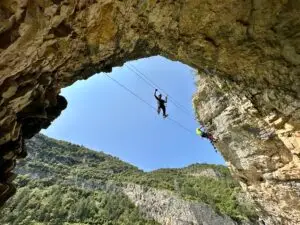
Nepalese bridge: a bridge over the void made of just two steel cables: one at foot level and the other to hold on to with your hands. It’s used to cross the gap between one wall and another, walking sideways along the cable.
For example, on the Salt del Botanal via ferrata, you can test yourself by crossing a 50-metre Nepalese bridge!
Tibetan bridge: a bridge with two cables to hold with your hands and only one cable for your feet to rest on. This bridge is crossed walking forwards, facing our goal.
Overhangs: one of the biggest challenges on a via ferrata, as the wall stops being vertical and starts to lean out, so we have to work harder physically with our arms.
There are quite a few via ferratas, such as Paret de les Arcades or Salt del Botanal, where the overhang is optional and can be avoided.
Pendulums: a really fun move where we swing, holding a chain, from one wall to another without resting our feet anywhere, just like Tarzan.
Want to try a pendulum over a lake? Don’t miss the Paret de les Arcades via ferrata!
Zip lines: another really fun move where, with the help of a pulley, we glide along a cable from one point of the wall to another.
If that sounds good, take a look at the Tossal de Miravet via ferrata.
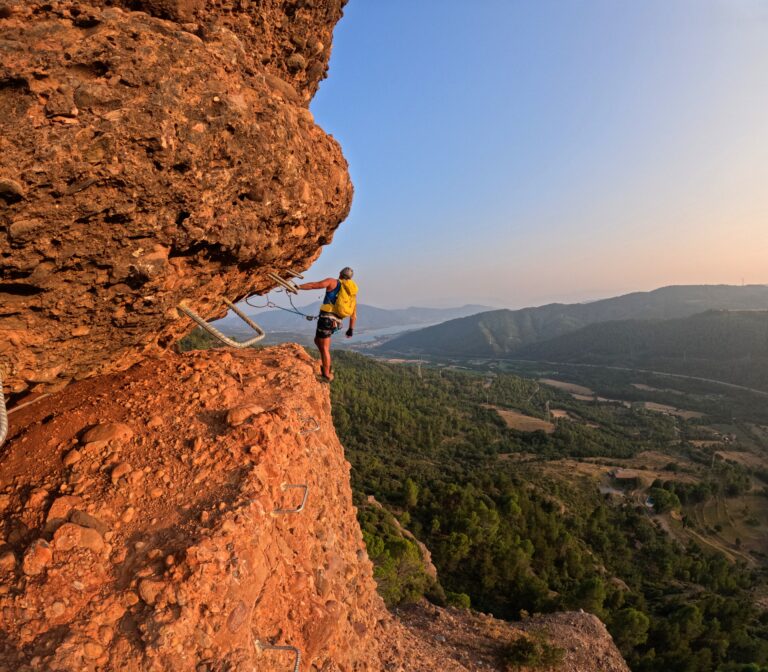
Ladders: in some parts where the walls form overhangs, hanging ladders are installed to make that section easier to get through.
You’ll find the ladder in the photo, with its impressive views, on the Roca Foradada via ferrata. Up for it?
On a single via ferrata you’ll find several of these elements combined along the route. They make the via ferrata really entertaining and put your skills to the test.
Hey, one thing though: the equipment on a via ferrata is always adapted to the level of the route, so on a beginner route you won’t find a demanding overhang or a super-long Nepalese bridge.
Further on we explain how the grades work, so you can see which one suits you best!
Gear you need to do a via ferrata safely
To start any via ferrata on the right foot, you need to bring the gear that lets you be comfortable and do the activity safely. And that’s what we’ll explain next, so you don’t forget a thing!
To keep it simple, we’ll split the gear into two types: via ferrata-specific gear and non-specific gear.
Via ferrata-specific gear
Specific gear is the equipment designed for doing a via ferrata, and it keeps you safe throughout the activity.
If you do an activity with us, this is the gear your guide will provide:
- Harness: a piece of safety equipment made of adjustable straps that lets us connect our body to other gear on the wall or to ropes. The most common are waist harnesses, but there are also full-body ones.
- Energy absorbers: the element that lets us clip on to the steel cables of the via ferrata. In case of a fall, its job is to prevent a long fall from the wall and also to absorb the impact so we don’t suffer any serious injury.
- Anchor lanyards (cow’s tails): normally a rigid element that lets us clip on to installations on the wall so we can rest, or to belay a person who is doing the activity with us.
- Helmet: as in any sport, the helmet protects our head from knocks in a possible fall and also from any falling rocks.
- Rope: although you don’t climb with a rope on via ferratas, it’s a safety element that comes in very handy if there’s an incident or if we have to help someone progress. It’s very important to know how to use ropes properly, because otherwise they can do more harm than good. That’s why it’s worth going with a guide or taking safety courses to learn all the basic manoeuvres.
- Gloves: great for protecting our hands from scrapes, since on a via ferrata we’re in contact with steel, stone and other metal elements. In the hot months they also stop your hands slipping with sweat.
- Carabiners, slings and flat tapes: essential for connecting yourself to the installation and securing yourself.
- Belay devices (grigri, reverso, etc.): let you control the rope if you need to belay someone or manage descents.
And don't worry: if you do a via ferrata with ADN Pirineus, you won't have to bring any of this gear from home. We'll lend it to you so you can gear up and do the activity with total comfort and safety.
Non-specific gear
Besides that, you also need to bring a few other items that aren’t via ferrata-specific.
As with any other mountain activity or route plan, we have to consider different aspects such as the weather, the duration of the activity, the time of year, the difficulty of the activity, and so on.
Depending on those, we’ll need to bring one set of gear or another.
To give you an idea, here’s a list of the gear we recommend bringing when we do a via ferrata.
Now you know: if you want to do a via ferrata in the Pyrenees (or anywhere), don’t forget any of this!
And if you have any questions, you can talk to us and we’ll advise you on whatever you need 😉
Don’t forget…
- Sports or mountain clothing
- Mountain shoes
- Backpack
- Water
- Sunscreen
- Sunglasses
- First-aid kit
- Food
Via ferrata difficulty grades: the K scale
Now that you know what via ferratas are like and what gear you need, it’s time to explain which via ferrata grades exist, both in Catalonia and in the rest of the world.
Via ferratas are graded from K1 to K7, where K1 is very easy and K7 is only suitable for people with a lot of experience and good fitness. This classification helps you know whether you’re facing a beginner via ferrata or a more demanding route.
First of all, you should know that within this sport there are different levels of difficulty: from K1 to K7.
But…
What is taken into account to decide a via ferrata's grade?
It’s not just about how much you climb, there are several key factors:
- Physical factor: whether the route is more or less physically demanding, which adds a certain difficulty to the via ferrata. A via ferrata with short, comfortable sections is not the same as one with overhangs or moves that make your arms and legs work. The more strength and technique you need, the higher the grade.
- Endurance: time also counts. A long route, even if it isn’t very technical, can end up being hard because of accumulated fatigue. The longer we spend on an activity, the more tired the body gets and the less well it performs compared with when it’s fresh and in top form. That’s why a via ferrata that lasts a long time adds difficulty through our body’s fatigue.
- Psychological factor: height and exposure matter a lot. Some sections are technically easy but, simply because you’re hanging over the void, can feel more intimidating than they seem. Confidence and managing vertigo are key.
- Equipment: rungs, cables and installations are what let you progress safely. When the equipment is comfortable and well placed, progression is smoother; when it’s more demanding, difficulty goes up.
- Terrain: moving over a compact wall is not the same as over a more irregular or exposed area. The surroundings and the type of rock also affect the feeling of safety and the overall difficulty.
A via ferrata isn’t hard because of one single factor, but because of the combination of all of them. That’s why it’s important to choose well and start with a beginner via ferrata in Catalonia or the Pyrenees before going for more demanding challenges.
Which via ferrata grades exist?
Via ferratas in Catalonia are graded using the Hüsler scale, which runs from K1 to K7 according to difficulty. A fun fact: the «K» comes from the German word «Klettersteig», which means via ferrata.
This scale is the usual reference that will help you easily identify the grade of each via ferrata.
Want to know what you’ll find at each via ferrata grade? Here’s a guide with all the details and real examples of via ferratas in Catalonia:
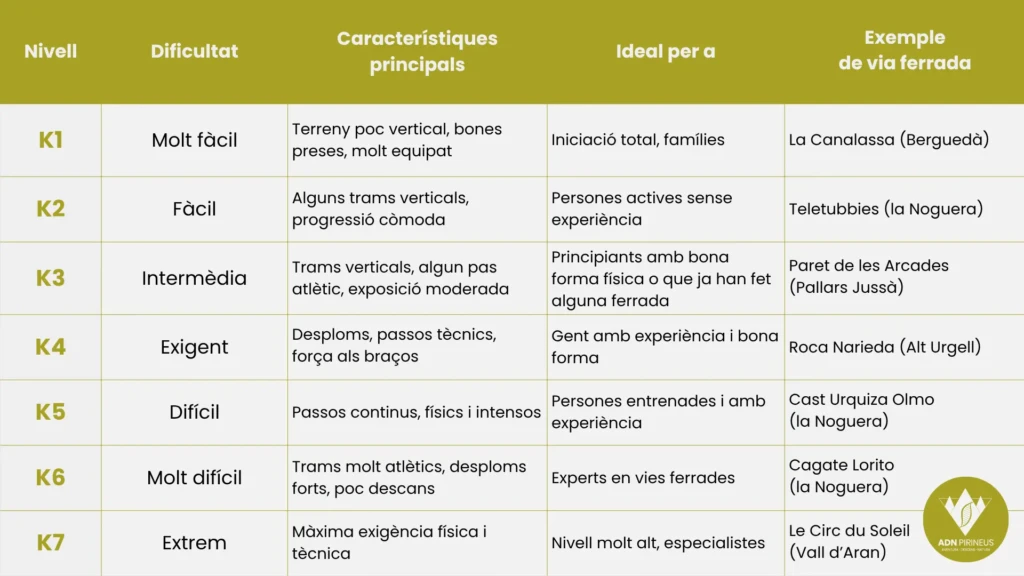
- K1: veeery easy via ferrata. Ideal for anyone doing their first via ferrata. Terrain that isn’t very vertical, with good holds and a constant feeling of safety. Example: La Canalassa (Berguedà)
- K2: easy via ferrata. Still beginner level, but there’s already a slightly more vertical section. Accessible to most people with a minimum level of fitness. Example: Teletubbies (la Noguera)
- K3: easy-intermediate via ferrata. Here we start to find vertical sections, a more athletic move or two and a little more exposure. It’s the most common grade and a very good option whether you’re a beginner or have already tried a via ferrata before. Example: Paret de les Arcades (Pallars Jussà)
- K4: demanding via ferrata. A K4 already requires good fitness and some experience. Overhangs, technical moves and sections where you need confidence and arm strength appear. Example: Roca Narieda (Alt Urgell)
- K5: difficult via ferrata. Now we’re talking physical via ferratas, with continuous, intense moves. It’s not just technique: endurance plays a very important role. Example: Cast Urquiza Olmo (la Noguera)
- K6: very difficult via ferrata. Example: Cagate Lorito (la Noguera)
- K7: extremely difficult via ferrata. The top grade. Very physical, technical and demanding routes, suitable only for via ferrata experts. Example: Le Circ du Soleil (Val d’Aran)
5 reasons to do a via ferrata with a certified guide
Like any adventure sport, via ferratas have their risks, especially if you don’t have in-depth knowledge of the technique, the gear and the wall. So if you want to do a via ferrata, we recommend doing it with a local, certified and expert guide.
We know the void is impressive and the mountain commands respect. That’s why our job isn’t only to take you up, but to make sure you have a great time with the peace of mind of knowing you’re in good hands.
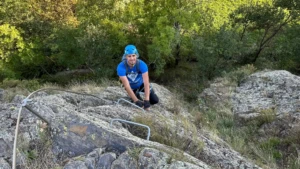
Here are 5 good reasons to book a via ferrata with an ADN Pirineus guide:
- Professional management and knowledge of the terrain: as local guides, we know every corner of the wall, the area’s weather and safe progression techniques. This lets us anticipate any surprise so you can enjoy the route with complete peace of mind.
- Technical gear and insurance: we equip you with approved gear (energy absorbers, harnesses and helmets) and teach you how to use it properly. In addition, all our activities include adventure sports insurance.
- Interpreting the surroundings: we like you to know the place you’re walking through. From the geology of the Terradets Gorge to the history of the Vall Ferrera, we’ll explain the secrets of the landscape around you.
- Photo and video report: we know you want to keep a memory of the adventure. So you can keep your hands where they belong and focus on the via ferrata, our guides take care of capturing the best moments and sending them to you at the end of the day.
- Via ferrata in small groups: we avoid crowds by working in small groups (2-6 people). This low ratio of participants per guide lets us offer personalised attention, adapt the pace to your needs and guarantee the highest safety standards.
In short, the goal is that your only «worry» is enjoying the activity. We take care of everyyything else!
Want to see all the via ferratas you can do with ADN Pirineus? Click here!
Via ferratas: an adventure sport for everyone
The great richness of via ferratas in Catalonia and the Pyrenees is their huge variety of routes, with options designed for every profile and level of experience.
Despite this accessibility, before choosing your challenge, it’s essential to assess your physical condition and previous mountain experience. The length of the route and the elevation gain are key factors to make sure you enjoy the experience from start to finish.
At ADN Pirineus, we help you select the ideal route and adapt the experience completely to you and your companions, making sure the pace and difficulty are right for the group.
Family via ferratas
If you’re looking for a different kind of family adventure, the via ferrata is the star activity. It lets the little ones experience verticality and contact with rock in a completely safe and fun way.
When doing activities with children, we select beginner routes (grade K1 or K2) where the via ferrata rungs are at a suitable distance for their height. It’s an excellent way to work on children’s motor skills and confidence in a wild natural setting.
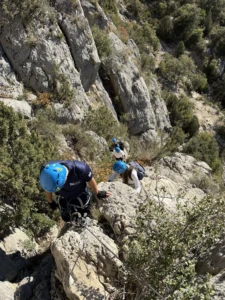
Want to do a via ferrata with children? Our recommendation:
- Salt del Botanal (a very simple beginner section, suitable for everyone).
- Teletubbies via ferrata (beginner level with spectacular views over the Canelles reservoir)
A via ferrata for two
Want to surprise your partner with an unforgettable gift?
A via ferrata is an ideal activity to do as a couple! It’s an experience that combines excitement, complicity and panoramic views you won’t find anywhere else. Sharing the challenge of getting past a pendulum or crossing a Tibetan bridge creates a unique bond and memories for life.
Hey, and if you like, we’ll prepare a gift voucher this cool for you!
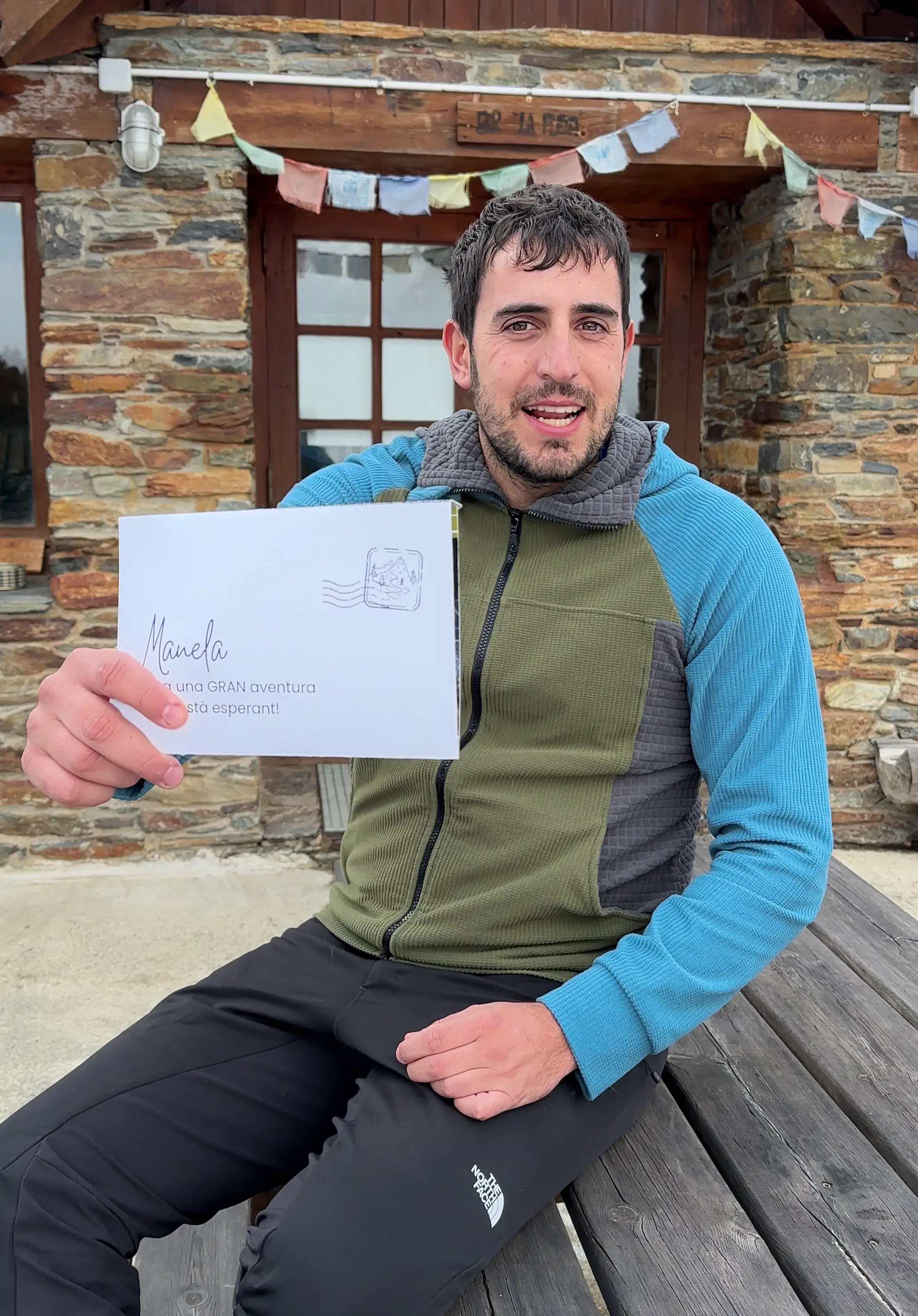
Feeling like doing a via ferrata with your partner? Then we recommend:
- Paret de les Arcades (grade K3 with a K5 option). A route above the Terradets reservoir with a great variety of elements: bridges, horizontal and vertical moves and a pendulum!
- Roca Foradada via ferrata (several grade options). With incredible views over La Pobla de Segur and the Sant Antoni reservoir!
Doing a via ferrata as a group
Looking for activities for groups of friends, companies (team building), hen and stag parties or special celebrations? Via ferratas are ideal for encouraging cohesion and shared fun.
At ADN Pirineus we guarantee that everyone in the group, from the boldest to the most cautious, will enjoy the route at their own pace.
Contact us and we’ll design a tailor-made activity for your group!
What is the best time of year to do a via ferrata?
If you’re thinking about doing a via ferrata, you may have wondered what the best time of year is to do one.
Well, we have very good news: in Catalonia you can do via ferratas all year round. That’s thanks to our climate, which means that whatever the season, we can find a pleasant spot to do a via ferrata.
But hey! To be honest, for us the best seasons are spring and autumn, because it’s neither too hot nor freezing cold.
Some tips (from a guide) for doing via ferratas in every season
We guide via ferratas all year round, and that has filled our backpack with experience for finding the best via ferrata depending on the season. Take note:
Winter
We’ll look for the sun whenever possible, because even when we’re moving, it’s cold in the shade and, since the rock doesn’t get any sun, our hands can get cold very quickly when we touch it.
It’s best to do the activity during the middle hours of the day.
Spring
One of the best seasons, though you can get a bit of everything: very hot days or cool ones. Depending on that, we’ll look for the best via ferrata or the best time of day to do them.
Summer
This is the hottest season, which means the rocks and iron get very hot during the middle hours of the day, and it’s also not advisable to do physical activity if temperatures are very high at those hours.
Knowing this, we’ll try to plan via ferratas where the shade falls, or do the activity early in the morning or in the evening if the via ferratas face east.
Autumn
A good season because temperatures start to be mild and we can comfortably enjoy via ferratas. On top of that, the landscape is tinged orange, which makes the views spectacular!
The ADN Pirineus guides are ready to do a via ferrata with you, whatever the season, you know… click here and book!
This guide is constantly being updated: soon we’ll add the list of the best via ferratas in the Pyrenees and the best via ferratas in Catalonia, the best time of year to do via ferratas, technical tips…